
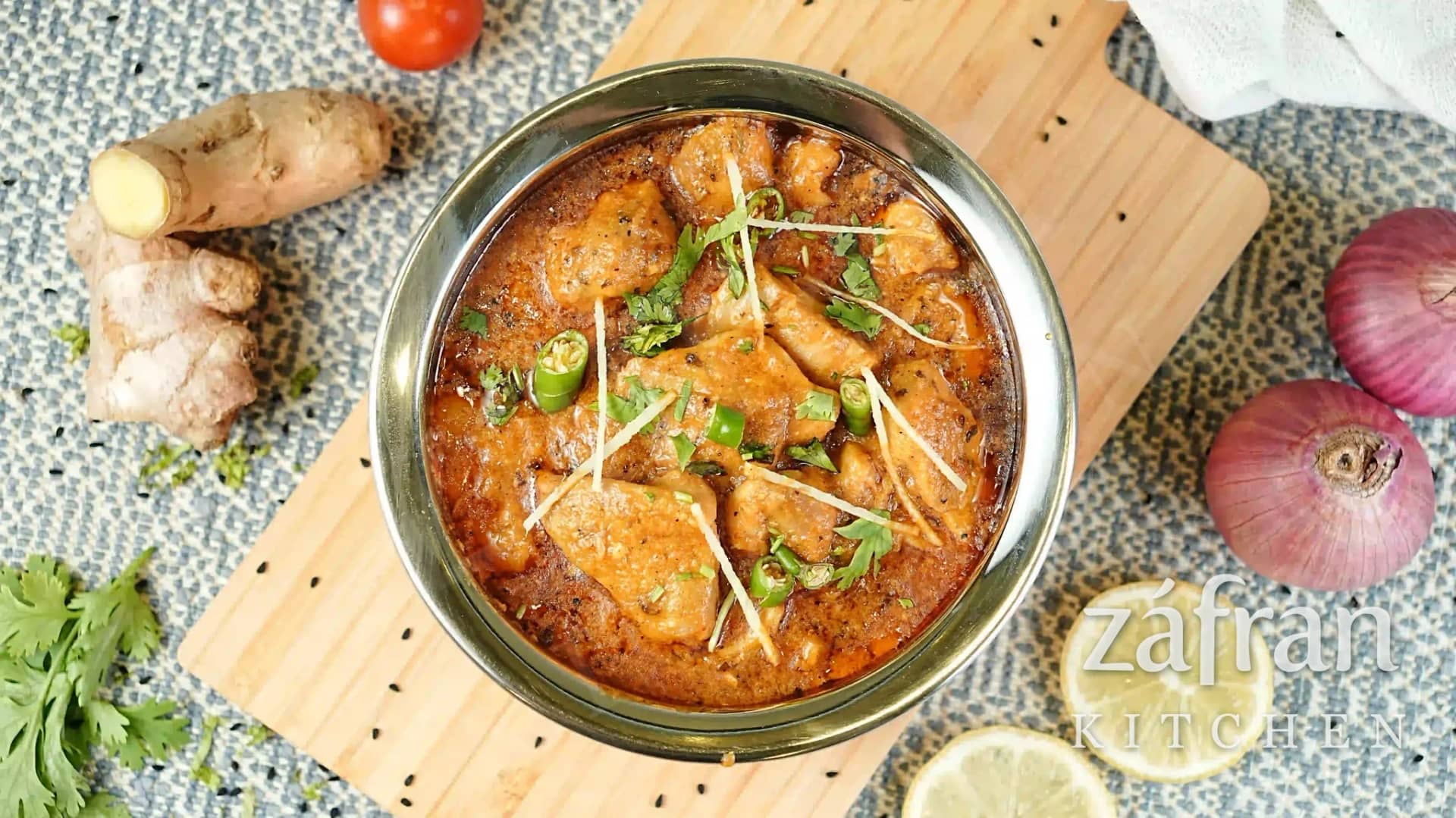
This is the question people ask at the counter more than any other, and the honest answer is that the menu will not tell you, because both dishes are named after a pot rather than a recipe.
Look it up and you will find sources contradicting each other. The most useful line in any of them is that the dish description matters more than the name. So here is ours, from the kitchen that cooks both.
The short answer
| Karahi | Handi | |
|---|---|---|
| The pot | A heavy wok. Wide, round, shallow | Deeper, narrower at the mouth. Clay or metal |
| The heat | High and fast | Lower and slower |
| The base | Tomato, ginger, green chilli | Cream, yoghurt, and in ours saffron and cashew |
| The result | Dry and concentrated. Little sauce | A standing sauce. Creamy, coats the bread |
| What it tastes of | The meat and the char | The base it simmered in |
Karahi reduces. Handi simmers. Everything else follows from that.
Why the pot shape decides the dish
This is not trivia. The vessel dictates the cooking.
A karahi is wide and shallow, which means a large surface area over a hard flame. Liquid leaves fast. That is the entire point — you are driving moisture off so what remains is meat, rendered fat and concentrated tomato. There is no standing gravy in a proper karahi and a karahi swimming in sauce has been made wrong.
A handi is deep and narrow, which traps steam instead of releasing it. Clay in particular holds heat evenly and gives it back slowly. That suits a dish built on yoghurt and cream, which would split and catch over the kind of flame a karahi needs.
You could not cook a handi in a karahi, or the reverse, and get the same dish. The shape is the recipe.
What we cook, exactly
The karahis — tomato led, cooked hard in the pan after you order:
| Chicken | Half | Full |
|---|---|---|
| Zafran chicken karahi — tomato, ginger, green chilli, coriander | 15 | 30 |
| Chicken white karahi — yoghurt and cream, no tomato, black pepper | 18 | 32 |
| Chicken Peshawari — cooked down hard, little beyond tomato and fat | 18 | 32 |
| Chicken kabab masala — seekh kababs broken into a thick masala | 18 | — |
| Mutton | Half | Full |
|---|---|---|
| Zafran mutton karahi — tomato and green chilli, a little more gravy | 30 | 60 |
| Mutton Charsi — namkeen, slow rendered, black pepper and coriander | 32 | 62 |
| Mutton white — yoghurt, cream and white pepper. Rich and mild | 32 | 62 |
| Mutton Shinwari — meat, tomato, salt, animal fat. Nothing hides | 34 | 64 |
| Mutton Peshawari — the Peshawar cut, cooked hard | 34 | 64 |
The handis — slower, creamier, a real sauce:
| AED | |
|---|---|
| Zafran chicken handi — saffron and cashew in the base | 24 |
| Chicken achari handi — pickling spices, mustard seed, a sour edge | 25 |
| Special butter chicken — tandoori chicken folded into tomato and butter | 25 |
| Chicken white handi — cream, yoghurt and white pepper, no chilli heat | 26 |
Note the white karahi. It is yoghurt and cream based, which sounds like a handi, and it is still cooked in the karahi over a high flame. That is the exception that proves the rule is about the pot and the method, not the ingredients list.
Which to order
Order a karahi if what you want is the meat. Concentrated, a bit charred at the edges, with just enough in the pan to pick up on bread. This is the dish Pakistani cooking is most known for and the one to judge a kitchen by. From AED 15 a half.
Order a handi if you want a proper sauce — something creamy that coats the bread and keeps going. It is also the safer order for a mixed table, because the white handi at AED 26 carries no chilli heat at all and the butter chicken at AED 25 is mild.
Order both if there are three or more of you. A half karahi at AED 15 and a handi at AED 24 with six roti at AED 6 is AED 45 and feeds three or four properly, with one dry dish and one wet one on the table, which is how a desi meal is supposed to be balanced.
Both take time
Worth saying because people order these at speed and then wait.
Nothing in either section is pre-made. A chicken karahi is fifteen to twenty minutes, a mutton karahi thirty or more, and a handi fifteen to twenty. That wait is the dish being cooked. If you need to eat quickly, order biryani or pulao instead — or message 050 720 8707 on the way over and it will be finishing as you park.
More on how each karahi style is cooked, on the five mutton karahis, on the handi section in detail, and on what is actually hot on this menu.
Finding us
Shop 8/1, ground floor, Amman Street, Ajman Industrial Area 2, beside Nesto Hypermarket. Free street parking directly outside, step free from the pavement, indoor and outdoor seating, families welcome at every table.
Open 7:30 am to midnight, every day. Call or message 050 720 8707. We answer in English, Urdu, Hindi and Arabic.
We do not deliver — a karahi in particular does not travel, because the thing that makes it good is how recently it left the flame. The full menu with every price is on this site.
Common questions
- What is the difference between karahi and handi?
- Both dishes are named after the pot they are cooked in. A karahi is a heavy wok, cooked fast over a high flame, and the result is dry and concentrated with tomato and chilli leading. A handi is a deeper, narrower pot, cooked slower and lower, and the result is a creamy standing sauce built on yoghurt and cream. Karahi reduces, handi simmers.
- Which is spicier, karahi or handi?
- On our card, the karahis are. The house chicken karahi is built on tomato, ginger and green chilli, while the handis lean on cream, yoghurt, saffron and cashew. But this varies by kitchen rather than by rule, and published sources disagree on it, so the dish description matters more than the name. The chicken white handi at AED 26 carries no chilli heat at all.
- Is a handi always made in a clay pot?
- Not always. A handi can be clay or metal, and both are traditional. Clay holds heat more evenly and releases it slowly, which suits a dish meant to simmer rather than sear. The word refers to the shape of the vessel, deep and narrow mouthed, rather than to the material.
- Which should I order?
- Order a karahi if you want the meat itself, concentrated, with bread to mop what little sauce there is. Order a handi if you want something creamy with a proper sauce, or if the table includes somebody who does not want chilli heat. At Zafran Kitchen a half chicken karahi is AED 15 and a chicken handi is AED 24.
- How long does each take?
- Both are cooked after you order. A chicken karahi is fifteen to twenty minutes and a mutton karahi thirty or more, because the flame does the work. A handi takes a similar fifteen to twenty minutes for chicken, since the point is a slow simmer rather than a hard sear. Neither is a quick order.
- Is karahi the same as kadai?
- Yes, it is the same word. Karahi, kadai, kadhai and karai are all transliterations of the same thing: the thick, round, deep pan that gives the dish its name. You will see every spelling on menus across the UAE.
- karahi vs handi
- difference between karahi and handi
- what is a handi
- what is a karahi
- karahi handi ajman
Hungry now
Order it instead of reading about it
The kitchen is open every day from half past seven in the morning until midnight.