
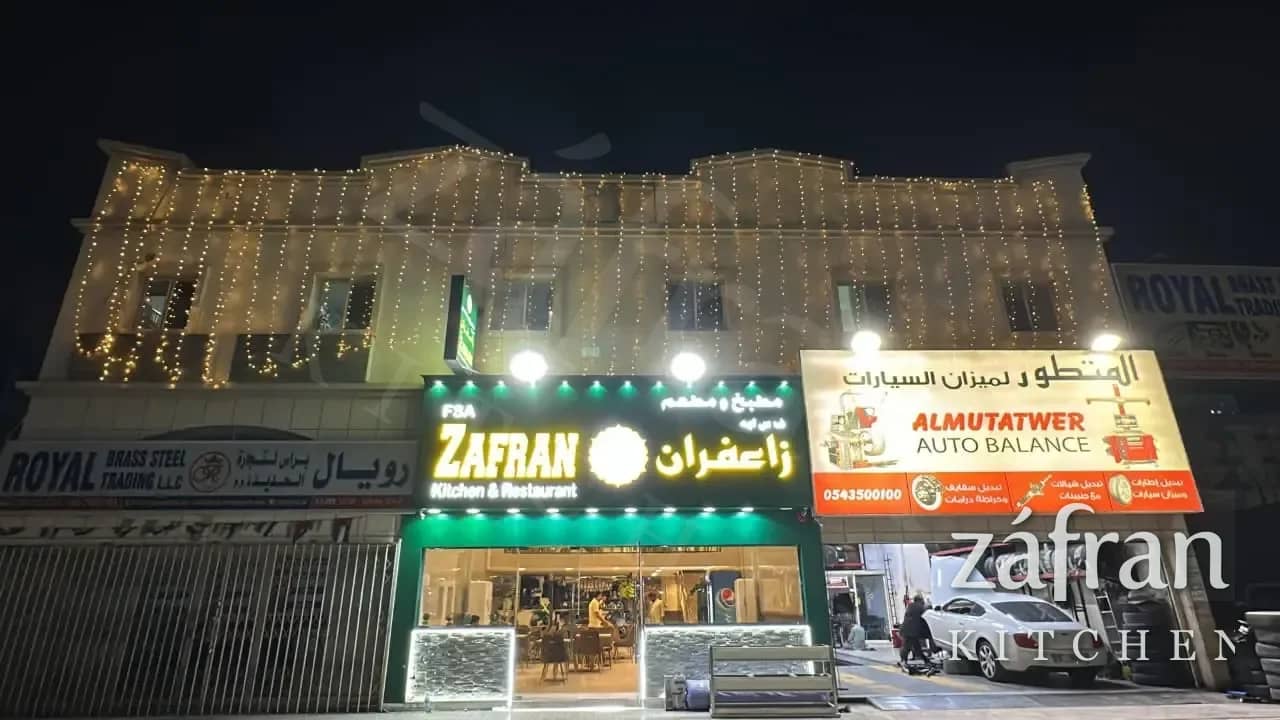
Every guide to eating in Ajman starts at the Corniche. There is a reason for that — four kilometres of seafront, hotel terraces, a genuine view — and if you only have one evening, it is a defensible way to spend it.
It is not where the city eats. That happens about four kilometres inland, in a neighbourhood with no view whatsoever, and it is the better meal.
The four kilometre split
Ajman is small enough that this is the whole geography you need.
The Corniche is the seafront. Promenade, beach, hotels, terraces. Priced for the view, which is fair, because the view is real. The food is broadly what a hotel terrace serves anywhere in the Emirates.
The Sanaiya — Ajman Industrial Area 1 and 2 — is four to five kilometres inland. Workshops, fabrication yards, spare parts dealers and the accommodation blocks behind them. Amman Street runs through it and Nesto Hypermarket is what everybody navigates by.
This is where most of the good desi food in the emirate is, for the unglamorous reason that it is where the people who eat desi food every day live and work. There is no decor budget anywhere in it and you should not go looking for one.
A meal here is AED 10 to AED 35 a head. The same meal on the seafront is a multiple of that, and it is not a better meal.
Four tests for a local place
These work anywhere, not just here, and you can run all four in about ninety seconds.
1. Check the roti price. A plain tandoori roti should be about AED 1 and a naan about AED 2. That is the Sanaiya rate. A place asking AED 4 or AED 5 for plain bread has told you where its margin comes from, and it is not the cooking. More on the bread test.
2. See if they will tell you no. Ask for the daal at nine in the evening. A kitchen that says "that is finished for today" cooked a batch that morning rather than a vat on Monday. Most people read that as a bad sign. It is the single best sign there is.
3. Ask how long a karahi takes. The honest answer is fifteen to twenty minutes for chicken and thirty or more for mutton, because it is cooked in the pan after you order. Anybody promising it in five is reheating.
4. Look at who is inside at eight in the evening. If the room is full of people who clearly live within two kilometres, you have found it. If it is full of people with cameras, you have found something else.
What to actually eat, and when
7:30 to 9 am — the best hour in the Sanaiya, and the one no visitor uses.
This is the most distinctive meal available to you in Ajman and almost nobody passing through has it. Mutton paya or beef nihari at AED 10 each, with a desi paratha at AED 2 and karak chai at AED 1. That is a complete, properly local breakfast for about AED 13.
Paya is trotters simmered overnight until the stock turns silky. Nihari is beef shank cooked all night and finished at your table with ginger, green chilli and lemon. Neither exists in any meaningful form on a hotel terrace. More on paya and more on nihari.
12 to 2 pm — lunch, fast. Biryani and plate food, because nobody breaking from a workshop has time for a karahi. Small chicken biryani AED 10. More on lunch.
7 to 10 pm — the evening, and the charcoal. This is when to order a karahi and actually sit with it, or something off the coals. Half chicken karahi AED 15, chicken tikka AED 10, full chargha AED 35 and it feeds three.
After 10 pm — the real test. Most kitchens here stop cooking well before the shutters come down. The question after ten is not what is open but what is still cooking. Ours is, until midnight.
The practical bit for visitors
It is a working neighbourhood, not a nightlife district. Workshops and spare parts yards. Quiet after dark, free street parking everywhere, and nothing remotely intimidating about it.
There is no scenery. None. That is the trade and you should know it before you drive over. It is also exactly why the cooking has to carry the place and why the prices have to be honest.
Do both in one evening. The Corniche is four and a half kilometres away. Sunset on the seafront and then dinner inland is a completely normal evening and it is the one we would suggest.
More on eating in Ajman as a visitor, on a full day in the emirate, on whether Ajman is worth the trip at all, and on the Sanaiya specifically.
If you have never eaten Pakistani food before, there is a guide to ordering it that assumes nothing.
Finding us
Shop 8/1, ground floor, Amman Street, Ajman Industrial Area 2, beside Nesto Hypermarket. Free street parking directly outside, ground floor, step free from the pavement. Indoor and outdoor seating, families welcome at every table, cash and card both accepted.
From the Emirates Road take the Ajman Industrial Area exit towards the Sanaiya, keep going past the tyre shops and turn onto Amman Street. About eight minutes from the exit.
Open 7:30 am to midnight, every day, including Fridays and public holidays. Call or message 050 720 8707. We answer in English, Urdu, Hindi and Arabic.
We do not deliver, so all of this assumes you are coming over. Each area of Ajman has its own page with the route in.
Common questions
- Where do locals eat in Ajman?
- Mostly in the industrial area, four to five kilometres inland from the Corniche, known locally as the Sanaiya. That is where the Pakistani and Indian kitchens are, where prices are lowest in the emirate, and where the people who eat that food every day live and work. A meal runs AED 10 to AED 35 a head.
- Is the Corniche a tourist area?
- It is the part of Ajman that guides lead with, and it is genuinely good: four kilometres of seafront promenade and beach. But it is priced for the view, and the food on a hotel terrace in Ajman is broadly the food on a hotel terrace anywhere in the Emirates. It is not where the city eats on a Tuesday.
- How can I tell a local restaurant from a tourist one?
- Four quick tests. Check the price of a plain roti, which should be about AED 1. See whether the kitchen will tell you something is finished for the day, because that means batch cooking. Ask how long a karahi takes, because the honest answer is fifteen to thirty minutes. And look at who is inside at eight in the evening.
- Is it safe and comfortable for visitors to eat in the industrial area?
- Yes. It is a working neighbourhood of workshops and spare parts yards rather than a nightlife district, there is free street parking, and family restaurants there have indoor seating and welcome families at every table. What it does not have is any scenery at all.
- What should a visitor order in the Sanaiya?
- Breakfast is the most distinctive meal and almost no visitor has it: mutton paya or beef nihari at AED 10 with a desi paratha at AED 2 and karak chai at AED 1, from 7:30 am. In the evening, a karahi cooked in the pan after you order it, from AED 15 a half, or something off the charcoal.
- How far is the industrial area from the Ajman Corniche?
- About four to five kilometres, which is a short drive. That is the entire distance between the Ajman most visitors see and the Ajman most of its residents eat in.
- where do locals eat in ajman
- local food ajman
- authentic ajman restaurants
- ajman like a local
- real ajman food
Hungry now
Order it instead of reading about it
The kitchen is open every day from half past seven in the morning until midnight.