
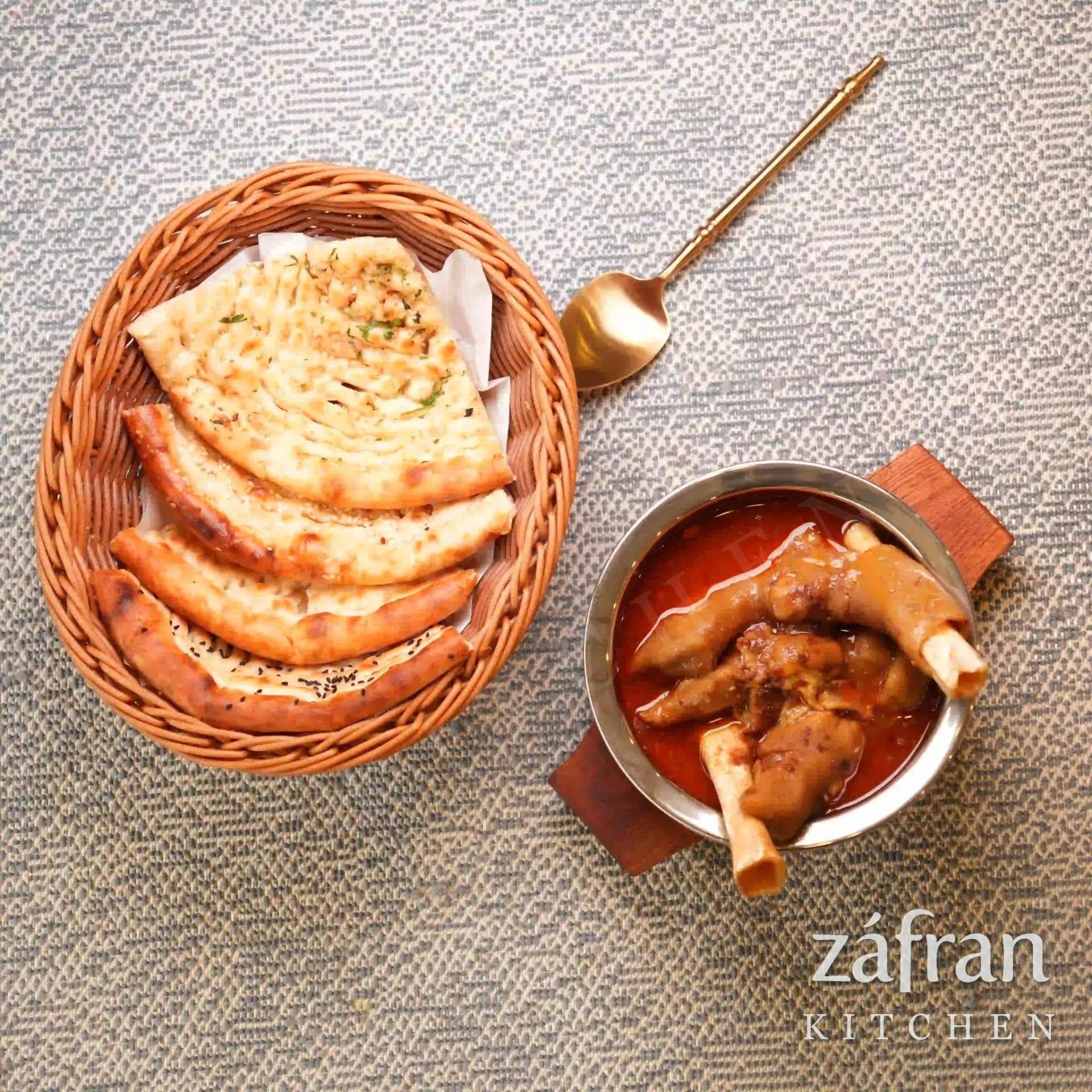
Paya is the dish most visitors to a Pakistani breakfast menu read once and skip. Trotters, in a bowl, at half past seven in the morning.
It is also one of the great breakfasts anywhere in the world, and it is AED 10. Here is the case for it.
What you are actually eating
Trotters: the lower leg and foot. There is almost no meat on them, and anybody ordering paya for the meat has misunderstood the dish.
What trotters are full of is bone, cartilage and connective tissue, which means collagen. Put them in water on a low heat for long enough and the collagen dissolves and converts to gelatine, and the thin stock you started with turns thick, glossy and genuinely silky.
That transformation is the whole dish. Not the meat. The liquid.
Why there is no fast version
Collagen will not be hurried. It needs many hours of low, steady heat, and no amount of pressure or technique gets you there in forty minutes.
So a paya pot is started the night before. It cooks while the restaurant is shut, and it is ready at first light. That is not a tradition anybody chose for romantic reasons — it is a direct consequence of how the ingredient behaves, and it is why paya is breakfast across Lahore, Karachi, Delhi and the Sanaiya alike.
It also means a kitchen either committed to paya last night or it did not. You cannot decide to serve paya at eleven in the morning.
The test: press your lips together
This is the one, and it takes a second.
Take a spoonful, then press your lips together. Properly made paya leaves them slightly tacky, because dissolved collagen does exactly what gelatine does. That stickiness is the proof the pot ran its full hours.
If the stock is thin and leaves nothing behind, one of two things happened: the trotters did not get their time, or the pot was topped up with water to stretch it through a busy morning. Either way you are drinking spiced water.
Second test: let the bowl sit for five minutes. Real paya starts to thicken visibly as it cools, for the same reason a stock sets in the fridge.
What it costs, and what to have with it
| AED | |
|---|---|
| Mutton paya | 10 |
| Beef nihari | 10 |
| Desi paratha | 2 |
| Sada paratha | 1 |
| Tandoori roti | 1 |
| Roghni naan | 2 |
| Karak chai | 1 |
| Lassi | 5 |
AED 13 for the full thing — paya, a desi paratha and a karak chai.
Eat it with bread and nothing else. No rice, no cutlery worth speaking of. A roghni naan at AED 2, enriched with milk and sesame, is the best possible partner because it is sturdy enough to carry a heavy stock without collapsing. A tandoori roti at AED 1 is the everyday choice.
Karak chai afterwards at AED 1. Paya is rich and the chai resets the palate.
Paya in winter
This is the season for it, and it is not a marketing line.
Late November to mid March is the only part of the UAE year when a heavy, hot, gelatinous breakfast is an obvious pleasure rather than a strange decision. Paya belongs to cool mornings, which is why it peaks in winter across the subcontinent and why the Sanaiya orders more of it in January than in July.
From 7:30 am, which in winter is a pleasant hour. There is more on the Ajman winter season.
If you have never had it
A few honest notes, because paya rewards knowing what to expect.
The texture is the unfamiliar part, not the spice. It is gentler than nihari and the heat is mild. What surprises people is the body of it — thick in a way no soup is.
It is heavy. A bowl at breakfast will hold you until the afternoon, and that is the design. Paya was breakfast for people going out to physical work.
If it is your first desi breakfast, order nihari or chana instead and come back for paya once you know you like the territory. Paya is not the beginner dish and pretending otherwise does nobody a favour. There is a guide to ordering Pakistani food for the first time if that is where you are.
Come early. One pot, cooked overnight, and when it is gone it is gone until tomorrow.
More on beef nihari and on the whole desi breakfast.
Finding us
Shop 8/1, ground floor, Amman Street, Ajman Industrial Area 2, beside Nesto Hypermarket. Free street parking directly outside, step free from the pavement, indoor and outdoor seating, families welcome at every table.
Open 7:30 am to midnight, every day, including Fridays and public holidays. Call or message 050 720 8707. We answer in English, Urdu, Hindi and Arabic.
We do not deliver. You can eat here or collect at the counter, and paya in particular is better eaten where it is poured. The full menu with every price is on this site.
Common questions
- Where can I eat mutton paya in Ajman?
- At Zafran Kitchen, Shop 8/1 on Amman Street in Ajman Industrial Area 2, beside Nesto Hypermarket. Mutton paya is AED 10 a bowl, served from 7:30 am every day. With a desi paratha at AED 2 and a karak chai at AED 1 it comes to about AED 13.
- What is paya made of?
- Trotters, the lower leg and foot of the animal. There is very little meat on them and that is not the point. They are almost entirely bone, cartilage and connective tissue, and simmering them for many hours dissolves the collagen into the stock, which is what turns it thick and silky.
- Why is paya cooked for so long?
- Because collagen does not break down quickly. It needs many hours of low, steady heat to convert into gelatine, and that conversion is the entire dish. There is no shortcut and no fast version. A paya pot is started the evening before and is ready at dawn, which is why it is a breakfast food.
- How can I tell if paya is real?
- Press your lips together after a spoonful. Properly made paya leaves them slightly tacky, because dissolved collagen is doing exactly what gelatine does. If the stock is thin, watery and leaves nothing behind, the trotters have not had their hours or the pot has been stretched with water.
- Is paya the same as nihari?
- No. Paya is mutton trotters, and the texture is the point: silky, gelatinous, gently spiced. Nihari is beef shank in a gravy thickened with a little wheat flour, with a much heavier spice profile. Both are AED 10 here, both are breakfast dishes, and most regulars are firmly loyal to one.
- Is paya good for you?
- It is traditionally eaten as a restorative, particularly in cold weather, and the collagen and gelatine in it are the reason. We are a kitchen rather than a clinic, so take the folk reputation as exactly that, but it is a dense and genuinely warming meal and the Sanaiya eats it on cool mornings for a reason.
- mutton paya ajman
- paya near me
- siri paya
- trotters soup uae
- paya breakfast ajman
Hungry now
Order it instead of reading about it
The kitchen is open every day from half past seven in the morning until midnight.