
Desi is one of those words that turns up on menus all over the UAE with no explanation, and most people ordering from them have never been told what it means.
It means of the country — from a word for homeland — and it is what people from Pakistan, India and Bangladesh call their own everyday cooking.
It is a category, not a cuisine, and it is mostly defined by what it is not: not restaurant invention, not export version, not a curry house menu. Home food and street food, cooked the way it is cooked at home.
What a desi menu actually contains
Five things, in roughly the order they matter.
1. Nashta — breakfast. The most distinctly desi meal there is, and the one visitors never have. Overnight dishes eaten at first light with bread and tea.
| AED | |
|---|---|
| Mutton paya — trotters simmered overnight until the stock turns silky | 10 |
| Beef nihari — shank cooked all night in a thickened gravy | 10 |
| Lahori chana — slow cooked white channa, vegetarian | 5 |
| Desi paratha — layered, hand folded, fried in ghee | 2 |
| Karak chai | 1 |
From 7:30 am. A full desi breakfast is about AED 13. More on nashta.
2. Ghar ka khana — the daily salan. Home food. Whatever was cooked that morning in one pot, served until it runs out. AED 5 to AED 10 small. A different one each day — aloo qeema, anda kofta, mutton kaleji, qorma, curry pakora. More on the weekly menu.
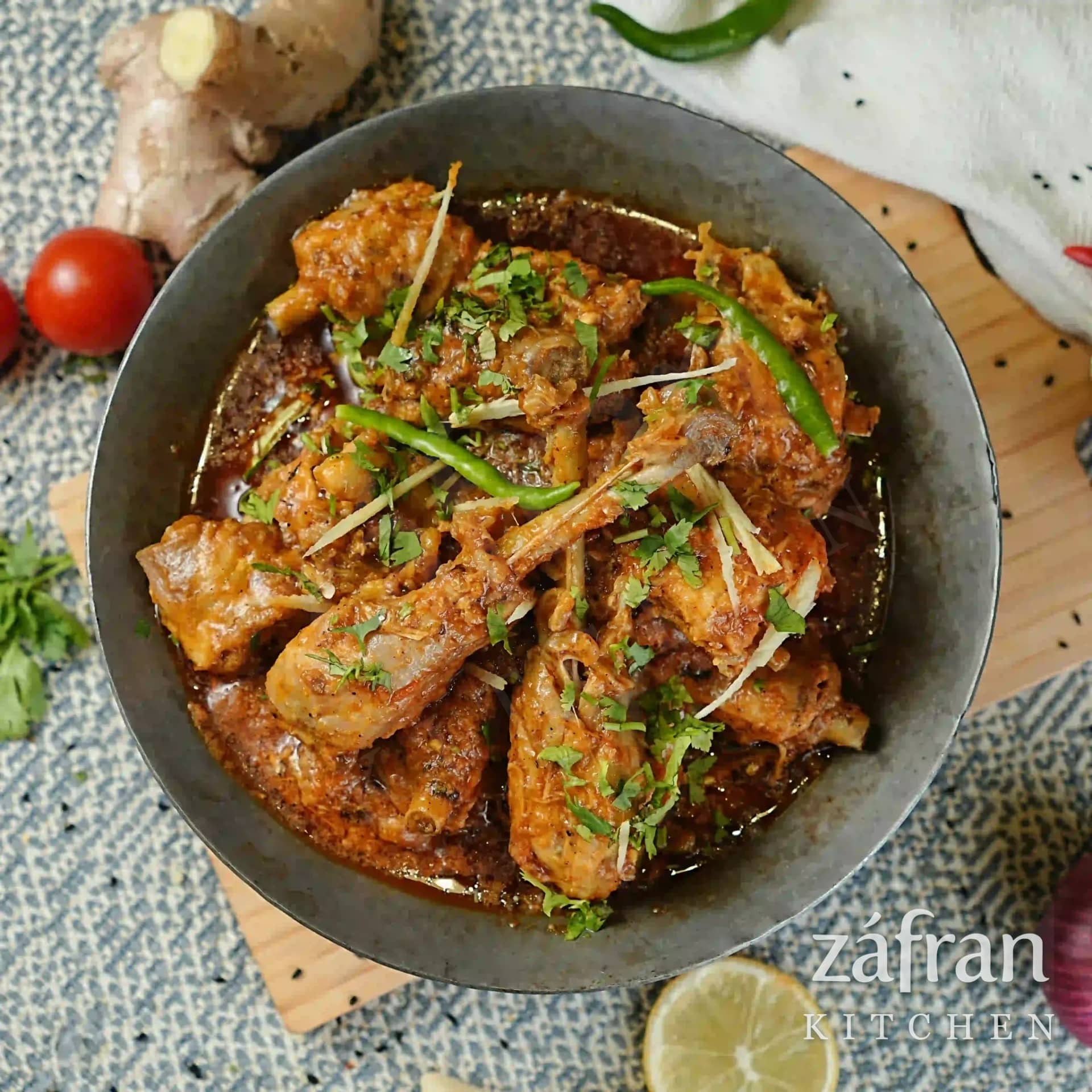
3. Karahi — the pan dish. Meat cooked hard in a heavy wok with tomato, ginger and green chilli, served in the pan it was cooked in. From AED 15 a half. This is the dish the cuisine is best known for.
4. Rice — biryani and pulao. Layered and spiced, or cooked in yakhni and mild. AED 10 small.
5. Bread, from the tandoor. Roti at AED 1, naan at AED 2. Bread is the cutlery, not a side.
Why desi is not "curry"
This trips people up constantly and it changes what you should order.
"Curry" as a menu word usually means a standing sauce, made separately and portioned over meat. It is a serviceable idea and it is how a lot of export menus are built.
Most desi dishes are not made that way.
A karahi has no sauce beyond what comes out of the meat and the tomato. It is seared hard in a wide pan so moisture leaves, and what remains is concentrated. A karahi swimming in gravy has been made wrong.
A pulao has no sauce at all. The rice is cooked in yakhni — stock from the meat and bones — so the flavour is inside the grain, not on it. More on that.
A handi does have a proper sauce — cream, yoghurt, slow simmering in a deep pot. That is the one closest to what most people mean by curry. Karahi versus handi.
The practical result: if you want something to pour over rice, order a handi or a salan. If you want the meat itself, order a karahi and bread.
Where the desi food is in Ajman
Four to five kilometres inland from the Corniche, in the industrial area — the Sanaiya — for the straightforward reason that it is where the people who eat desi food every day live and work.
There is no view and no decor budget anywhere in it, which is exactly why the cooking has to carry it and why a full meal is AED 10 to AED 35 a head rather than AED 55 and up on the seafront. More on where the locals eat.
What to order first
If you want the famous dish: a half Zafran chicken karahi at AED 15 with four tandoori roti at AED 4 — AED 19, feeds two.
If you want the most desi thing on the card: breakfast. Beef nihari at AED 10 with a desi paratha, from 7:30 am.
If you want cheap and real: daal of the day at AED 5 with two roti — AED 7, and a full meal rather than a snack.
If chilli is a problem: chicken white handi at AED 26, which carries no chilli heat, or chicken pulao at AED 10, the mildest main here. You can also ask for a dish to be made milder at the counter. More on the heat.
If you are eating here most days: the monthly mess at AED 200 for one meal a day works out at about AED 6.70 a meal.
If you have never eaten any of this before, there is a guide that assumes nothing, and one on what separates Pakistani from Indian cooking.
Where to eat desi food in Ajman
Shop 8/1, ground floor, Amman Street, Ajman Industrial Area 2, beside Nesto Hypermarket. Free street parking directly outside, step free from the pavement, indoor and outdoor seating, families welcome at every table.
Open 7:30 am to midnight, every day, including Fridays and public holidays. Call or message 050 720 8707. We answer in English, Urdu, Hindi and Arabic.
We do not deliver. You can eat here or collect at the counter. The full menu with every price is on this site.
Common questions
- What does desi food mean?
- Desi means of the country, from a word for homeland, and it is what people from Pakistan, India and Bangladesh call their own everyday cooking. It is not a cuisine so much as a category: home food and street food rather than restaurant inventions, and it covers breakfast, bread, rice, slow cooked meat and the daily salan.
- Where can I find desi food in Ajman?
- Mostly in the industrial area, four to five kilometres inland from the Corniche, because that is where the people who eat it every day live and work. At Zafran Kitchen on Amman Street a daal is AED 5, a small chicken biryani is AED 10 and a half chicken karahi that feeds two with bread is AED 15.
- Is desi food the same as curry?
- No, and the difference matters when you order. Curry as a menu word mostly describes a standing sauce made separately and portioned out. Most desi dishes are not built that way: a karahi has no sauce beyond what comes out of the meat and the tomato, and a pulao has no sauce at all because the flavour is inside the rice.
- What is ghar ka khana?
- Home food, literally. On a desi menu it means the daily salan rather than the showpiece dishes: whatever was cooked that morning in one pot and is served until it runs out. At Zafran Kitchen that is the weekly menu, from AED 5 small and AED 8 large, with a different salan each day.
- What is the most desi thing to order?
- Breakfast, and specifically paya or nihari at AED 10 each from 7:30 am. Both are overnight dishes, both are eaten with paratha and karak chai, and neither has any equivalent on a Western or a hotel menu. A karahi is the more famous dish, but nashta is the more distinctly desi meal.
- Is desi food always spicy?
- No. There is a whole mild half of a desi menu built on yoghurt, cream and pepper rather than chilli: the white karahi, the white handi, butter chicken and the pulaos all carry little or no chilli heat. You can also ask for a dish to be made milder when you order it.
- desi food ajman
- desi restaurant near me
- what is desi food
- desi khana ajman
- authentic desi food uae
Hungry now
Order it instead of reading about it
The kitchen is open every day from half past seven in the morning until midnight.