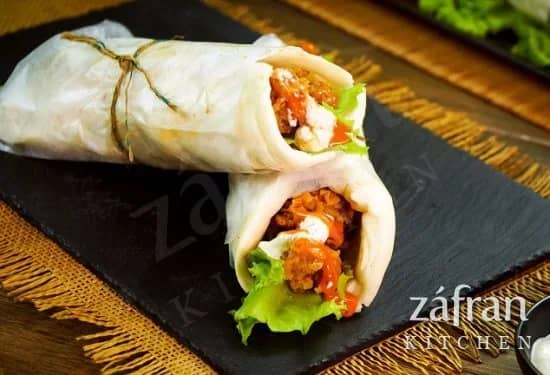
If you search shawarma in Ajman you will be given a list of Syrian and Lebanese places, most of them good, most of them from about AED 6. That list is correct and if the classic shawarma is what you want, go and eat one.
This is a different dish with the same name, and nobody writes about it. Ours is AED 7.
The three things that make it Pakistani
| Arabic shawarma | Pakistani shawarma | |
|---|---|---|
| The bread | Khubz or thin saj, soft and neutral | Paratha, layered and fried on a tawa |
| The sauce | Garlic toum, or tahini | Chatni, green, coriander and mint |
| The fries | On the side, if at all | Rolled inside with the filling |
Everything that follows comes from those three swaps.
The paratha changes it most. A khubz wrap is there to hold the filling and get out of the way. A paratha is an ingredient — layered, hand folded, fried in ghee on a griddle, rich and chewy. It brings its own fat and its own flavour, and it makes the whole thing considerably heavier.
The chatni changes the direction. Garlic toum is sharp and dairy-white. A coriander and mint chatni is green, herbal and spiced, and it pushes the roll towards the subcontinent rather than the Levant.
The fries inside sound like a gimmick and are not. They soften against the chatni and add starch in the middle of the roll, which is the texture people who grew up on this specifically miss when they get a version without them.
What it is actually for
It is the AED 7 order, and the honest use case is this: you want something hot, substantial and immediate, you are not sitting down for a karahi, and you do not want a snack that leaves you hungry in an hour.
In Karachi this is street food eaten standing up, usually called a paratha roll rather than a shawarma. The UAE name changed because shawarma is the word people here search for, but the dish did not.
It is also the thing to order for a child who is not going to get through a karahi, and the thing to order at eleven at night when the kitchen is still open and a full meal is too much.
The rest of the snacks section
Worth listing properly, because this part of the card gets overlooked.
| AED | |
|---|---|
| Pakistani shawarma — chicken, chatni and fries in paratha | 7 |
| Anda shami burger — shami kabab and a fried egg in a soft bun | 6 |
| Samosa chat, small — samosa broken into channa, dahi, imli, chaat masala | 5 |
| Samosa chat, large | 8 |
| Samosa, single, fried to order | 2 |
| Shami kabab, single patty | 2 |
The anda shami burger at AED 6 is the quiet one. A shami kabab, which is a soft lentil and meat patty, with a fried egg, in a bun. It should not work as well as it does.
Samosa chat at AED 5 is the one to get if you want something with everything happening at once — hot, cold, sour, crisp and soft in the same bowl.
There is more on chai and what to eat with it.
Where to go for the other one
Said plainly, because a page that claims every version of every dish is worth nothing.
For a classic Arabic shawarma, go to a Syrian or Lebanese shawarma house. Ajman has several with long queues and decades of practice, prices start around AED 6, and they are better at that specific sandwich than a Pakistani kitchen has any business being.
Come here for the paratha version. Different bread, different sauce, fries on the inside, AED 7.
Finding us
Shop 8/1, ground floor, Amman Street, Ajman Industrial Area 2, beside Nesto Hypermarket. Free street parking directly outside, step free from the pavement, indoor and outdoor seating, families welcome at every table.
Open 7:30 am to midnight, every day, including Fridays and public holidays. Call or message 050 720 8707 and it will be ready when you arrive. We answer in English, Urdu, Hindi and Arabic.
We do not deliver, but a shawarma is the one thing on this menu built to travel, and you can collect it at the counter. The full menu with every price is on this site, and there is more on what else is open late.
Common questions
- What is a Pakistani shawarma?
- Chicken, chatni and fries rolled inside a paratha. The differences from an Arabic shawarma are the wrap, the sauce and the fries: a griddled paratha instead of khubz or saj bread, a coriander and mint chatni instead of garlic toum or tahini, and potato fries rolled in with the filling rather than served beside it. At Zafran Kitchen it is AED 7.
- How is it different from a normal shawarma?
- Three things. The bread is a layered paratha fried on a tawa, which is richer and chewier than khubz. The sauce is a green coriander and mint chatni rather than garlic or tahini. And the fries go inside the roll. The result is a heavier, softer, spicier thing than an Arabic shawarma, and people tend to have a firm preference.
- How much is shawarma in Ajman?
- Arabic shawarma in Ajman generally starts from around AED 6 at the Syrian and Lebanese places, which is the right place to go for the classic version. The Pakistani shawarma at Zafran Kitchen on Amman Street in Ajman Industrial Area 2 is AED 7.
- Is it the same as a paratha roll?
- Essentially yes. In Karachi the same thing is usually called a paratha roll, and in the UAE it is often sold as a Pakistani shawarma because that is the word people search for. The dish is the same idea either way, and ours is a chicken, chatni and fries roll in a paratha.
- What else is in the snacks section?
- An anda shami burger at AED 6, which is a shami kabab and a fried egg in a soft bun. A single samosa at AED 2. Samosa chat at AED 5 small and AED 8 large, which is samosa broken into channa, dahi, imli and chaat masala. And a single shami kabab at AED 2.
- Should I order the Arabic shawarma or the Pakistani one?
- If you want the classic — lean, garlicky, tightly wrapped in thin bread — go to a Syrian or Lebanese shawarma place, and Ajman has very good ones. If you want something heavier and spicier with a fried paratha around it and chatni through it, that is the Pakistani version, and it is a different craving rather than a better dish.
- pakistani shawarma ajman
- shawarma near me ajman
- paratha roll
- chicken roll ajman
- shawarma price ajman
Hungry now
Order it instead of reading about it
The kitchen is open every day from half past seven in the morning until midnight.