
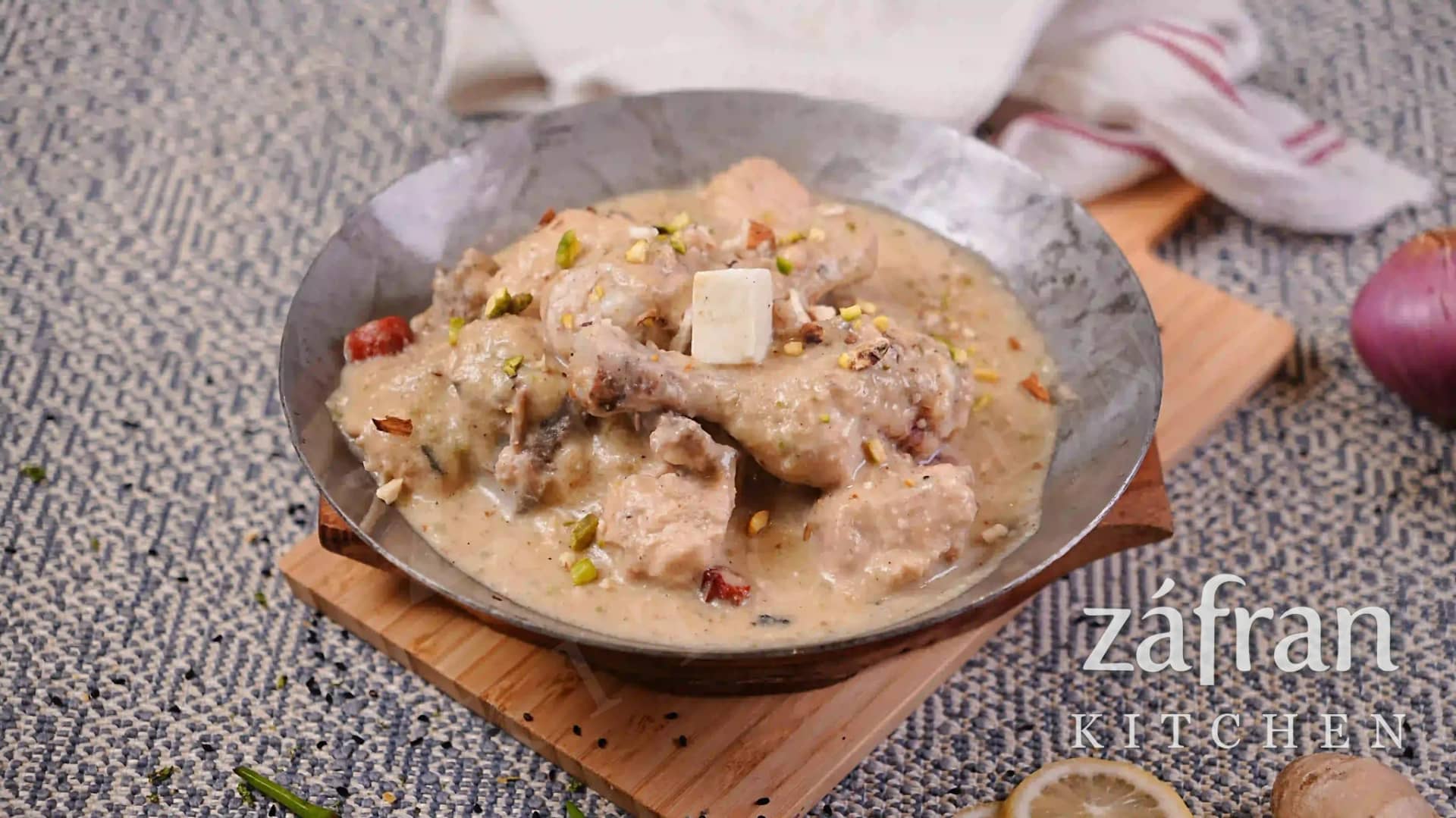
White karahi is the dish people order second. They come for the Shinwari, see something pale arrive at the next table, and ask what it was.
Chicken white karahi is AED 18 a half and AED 32 a full. Mutton white karahi is AED 32 a half and AED 62 a full. Here is what it actually is, and when it is the right order.
What makes a karahi white
Everything you expect in a karahi, with two things taken out and two put in.
Out: tomato and red chilli. Those are what give a standard karahi its colour, its acidity and its heat, and a white karahi has none of them.
In: yoghurt and cream, plus white pepper doing the work the chilli would otherwise do. White pepper is a different kind of hot: it builds slowly at the back of the throat rather than hitting the front of the mouth, and it does not burn. People who find green chilli uncomfortable almost always get on with it.
The technique is the same as any karahi, cooked in the pan over a high flame after you order it, which is why it still takes fifteen to twenty minutes for chicken and thirty or more for mutton. The dairy is what makes it harder to cook than it looks: too hot and the yoghurt splits, too slow and it goes claggy.
White karahi against the others, honestly
| Karahi | Base | Heat | Half | Full |
|---|---|---|---|---|
| Zafran chicken | Tomato, ginger, green chilli | Medium | AED 15 | AED 30 |
| Chicken white | Yoghurt, cream, white pepper | None | AED 18 | AED 32 |
| Chicken Peshawari | Tomato, cooked down hard | Medium | AED 18 | AED 32 |
| Zafran mutton | Tomato, green chilli, more gravy | Medium | AED 30 | AED 60 |
| Mutton Charsi | Animal fat, black pepper, no tomato | Medium | AED 32 | AED 62 |
| Mutton white | Yoghurt, cream, white pepper | None | AED 32 | AED 62 |
| Mutton Shinwari | Meat, tomato, salt, own fat | Medium | AED 34 | AED 64 |
| Mutton Peshawari | The Peshawar cut, cooked hardest | Medium | AED 34 | AED 64 |
The two worth comparing directly are white and Shinwari, because they are near opposites and people often ask for one meaning the other.
Shinwari is the stripped back one: meat, tomato, salt, green chilli and the fat that renders out of the meat. Nothing else. It is dry, direct, and there is nowhere for a poor cut to hide, which is why it is the dish that tells you most about a kitchen.
White is the rich one: no tomato, no chilli, dairy instead. It is softer, rounder and far more forgiving at a table with mixed tastes.
There is a separate piece on how Shinwari, Charsi and white karahi are cooked if you want the method rather than the comparison, and the full mutton karahi line-up with sizes if you are deciding what to order for a table.
When white karahi is the right call
Children at the table. This is the main one. No chilli means the children eat the same dish as everybody else rather than something separate and sad. The chicken white handi at AED 26 is the other option here.
Somebody new to Pakistani food. White karahi is recognisably the same family of cooking as everything else on the card without the heat being the first thing you notice.
You already ordered something hot. A table that has a Shinwari on it is better off with a white karahi beside it than a second tomato dish. Contrast beats repetition.
You want bread to matter. White karahi has an actual sauce, so a roghni naan at AED 2 earns its place in a way it does not next to a dry Shinwari.
What to order with it
Plain tandoori roti at AED 1 if you want the karahi to be the whole event, roghni naan at AED 2 if you want to mop. A salty lassi at AED 5 rather than a sweet one, because the dish is already rich. Kheer at AED 8 to finish, which picks up where the cream left off.
For two people: half chicken white karahi at AED 18 with four roti comes to AED 22. For a family of four: full mutton white karahi at AED 62 with six roti is AED 68.
Come and eat it here
A white karahi is a dairy dish cooked dry in a pan, which means it is at its best in the first few minutes and does not reward being carried home. This is one to eat at the table.
We are at Amman Street, Ajman Industrial Area 2, near Nesto Hypermarket, open every day from 7:30 am to midnight, with free parking directly outside. We do not deliver.
If you are driving in from elsewhere in Ajman, there is a page for each area with the route. Order ahead on 050 720 8707 and a mutton karahi will be finishing as you park.
Common questions
- What is white karahi?
- A karahi built on yoghurt, cream and white pepper instead of tomato and red chilli. There is no tomato in it at all, which is what keeps it pale, and no chilli heat. The pepper gives it warmth rather than burn.
- How much is white karahi in Ajman?
- At Zafran Kitchen chicken white karahi is AED 18 for a half and AED 32 for a full. Mutton white karahi is AED 32 for a half and AED 62 for a full. A half feeds two with bread, a full feeds four.
- What is the difference between white karahi and Shinwari karahi?
- They are near opposites. Shinwari is meat, tomato, salt, green chilli and the fat rendered from the meat, cooked dry with nothing to hide behind. White karahi has no tomato and no chilli, and is built on yoghurt and cream so it stays rich and pale. Shinwari tastes of meat and tomato, white karahi tastes of meat and pepper.
- Is white karahi spicy?
- No. It carries no chilli heat at all. The white pepper gives it a gentle warmth at the back of the throat rather than the front-of-the-mouth burn of green chilli. It is the mildest thing in our karahi section and the right order for children.
- Which is better, white karahi or Shinwari?
- Neither. They answer different questions. Order Shinwari if you want the meat itself to be the whole dish, and white karahi if you want something rich that everyone at the table including children can eat.
- white karahi ajman
- chicken white karahi
- mutton white karahi
- shinwari karahi
- karahi near me
Hungry now
Order it instead of reading about it
The kitchen is open every day from half past seven in the morning until midnight.